Finding Your T1D Community After Diagnosis
A newly diagnosed Jersey woman says the T1D support group that welcomed her became her first friends on the island. A longtime T1D on why that ordinary fact is the most under-prescribed treatment in Type 1 care.

“You’re kind of my first set of friends here”
I read that line three times.
It’s from a BBC story by Chris Craddock about Beth Edwards, a 26-year-old in Jersey who was diagnosed with Type 1 Diabetes in January 2023. She had moved to the island, fallen very ill, been admitted to A&E, and walked out a few days later with a disease that, in her words, “changes your life drastically.” She told the BBC reporter that the peer group she found through the local charity Diabetes Jersey — the yoga sessions, the other T1Ds — became her first proper friends on Jersey. “That support network is so valuable because they know what you’re going through.”
That is the whole article, really. That one line. Everything else I am about to write is footnote.
I was diagnosed in 1983. Beth was diagnosed in 2023. The forty years between those two dates changed almost everything about this disease — the insulin is cleaner, the meters are smaller, the pumps are smarter, the continuous glucose monitors did not exist and now they basically run the show. But the moment when a newly diagnosed T1D meets another T1D for the first time and thinks oh, you actually get it — that moment has not changed at all. It is still the single most under-prescribed treatment in Type 1 care.
The thing the hospital discharge packet leaves out
When you are discharged from hospital after a Type 1 diagnosis, you are handed a lot of paper. You get a glucose meter, probably a starter supply of insulin pens, a sharps container, a sheet with carbohydrate ratios, a pamphlet on hypoglycemia, a clinic appointment, and — if the team is good — a phone number for a diabetes educator.
What you are not handed is a person.
And this is where so many newly diagnosed T1Ds, especially adult-onset ones, quietly fall off a cliff. You go home and try to perform the instructions, and within a week you realise that every decision — what to eat, when to walk, when to bolus, when to sleep, whether the number on the screen means what you think it means — is now yours. It is a genuine psychological shift. The clinical name is diabetes distress, and large cohort studies have been flagging it for years. About a third of adults with T1D meet criteria for it at any given time. In the first twelve months after diagnosis, the rate is higher.
What Beth found in Jersey is the thing the discharge packet cannot give you — the company of people who have already done a Tuesday. Who already know what a 3 a.m. low feels like. Who know what it is like to carb-count a slice of pizza and guess wrong. Who do not need the disease explained.
Why adult-onset diagnosis is its own kind of lonely
One reason the Beth Edwards story caught me is that her diagnosis came as an adult, on an island she had just moved to. Adult-onset Type 1 — once called LADA when it’s slow-moving, often just “adult T1D” — affects hundreds of thousands of people in the UK alone, where the total T1D population sits around 400,000. And adults who get diagnosed run into a specific version of loneliness that pediatric patients do not.
Children diagnosed with Type 1 are usually folded into a system: a pediatric endocrinology team, school nurses, summer camps, parents who talk to other parents in the hospital corridor. Adults get handed a leaflet.
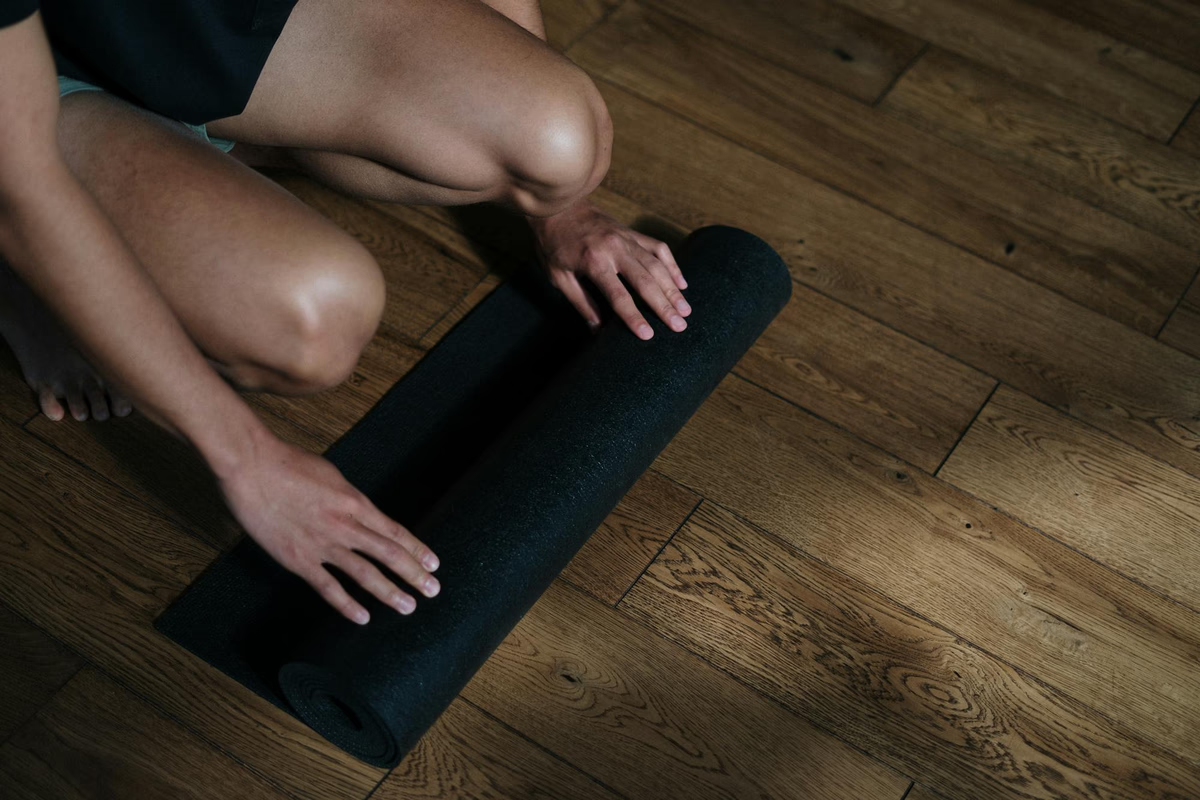
That is why something as ordinary as a yoga mat in a community hall, labelled for people with T1D, is actually a lifeline. It is low-commitment. You do not have to be articulate about your feelings. You show up, you breathe, the person next to you has the same pump bulge under their t-shirt, and afterwards someone mentions over tea that their Dexcom also lost signal on Sunday night. That is how it starts.
Bill O’Brien, who chairs Diabetes Jersey, told the BBC reporter exactly this: “The support groups are so important to young people like Beth, because they give them an opportunity to meet and discuss their issue with like-minded people.” It sounds obvious. It is obvious. And yet it is still not standard-of-care in most countries, which is why people like Beth have to find it themselves.
What four decades of T1D taught me about community
Here is the part the pamphlet cannot tell you, so I will.
When I was first diagnosed, I knew no other T1Ds. For years I thought my experience of this disease was weird, or wrong, or particular to me. I thought I was bad at it. It turns out almost every feeling I had — the irrational anger at a meter reading, the exhaustion of always having to plan the next snack, the petty grief of missing a normal meal out with friends — is universal. I only learned it was universal by meeting other T1Ds, one at a time, over decades.
That is what community collapses. It turns a private, silent, “I must be bad at this” experience into a shared, spoken, “oh thank god it’s not just me” experience. The therapeutic name for it is validation. The plain name is not being alone with it. I wrote about one of the stranger forms this validation takes in Comedy as a Coping Tool for Type 1 Diabetes — the dark humour that only lands in a room full of other T1Ds.
Here is what I have learned about how to find that, at whatever age and wherever you are:
1. Start with the charity in your country
Almost every country has at least one. Diabetes UK in Britain, Diabetes Jersey on Jersey, JDRF (now Breakthrough T1D) internationally, the American Diabetes Association in the US, Beyond Type 1 online. These organisations run local groups, meetups, and support lines. You do not have to volunteer, donate, or advocate. You can just show up. The resources we gather on the long-term journey pillar go into more depth on building a long-haul life with this disease.
2. Take a low-stakes door in
A yoga class, a walking group, a kids’ camp, an educational evening. Something where the main activity is the activity, not the disease. That is kinder on someone newly diagnosed than a full-ring support circle, which can feel heavy too early. Beth’s charity got this right — yoga first, conversation after.
3. Find one online space that fits your temperament
For some people it is the T1D side of Instagram. For others it is the #T1D hashtag on X, a Reddit sub, or a single WhatsApp group of six local T1Ds. The specific platform does not matter. Finding a handful of familiar usernames who feel like peers — that is the point.
4. Keep an eye on your own diabetes distress
If you notice that the disease is eating your week, your sleep, your mood, or your relationships, talk to your endocrinologist and, if possible, a psychologist who has worked with chronic illness. The ADA’s psychosocial care guidelines recommend routine screening for distress for exactly this reason. Community is powerful, but it is not a substitute for clinical mental-health support when the load gets heavy.
5. When you are ready, be the person in the room
I write about some of the people who have been the person in the room for me — and for a lot of other T1Ds — in Women Who Refuse to Be Outdone. Every one of them made this disease a little more possible for the rest of us.
At some point — maybe in a year, maybe in ten — you will be the person in the room who has been doing this for longer than someone else. You will not feel like an “old timer”. You will still feel newly diagnosed on the inside. Show up anyway. Juliette Hart, the 61-year-old also quoted in the BBC piece, was diagnosed at 15, and she told the reporter she keeps attending the sessions because “young people come along, and they can see the old timers like me and see I’m hanging on in there.” That sentence is the whole point of this disease’s community. People hang on in there. New people need to see that.

The part of Beth’s story that rarely gets written up
Reading the BBC piece, the reporter gently foregrounded something that I think deserves a louder mention. Beth told him she felt “a responsibility” to talk openly about her T1D, and that she had received “so many messages” of support after she did. She was not expecting the responses. She was expecting to describe a chronic illness into the void.
What actually happens, in my experience, is what happened to her — the second you speak, other T1Ds surface. People you worked with for years turn out to wear CGMs. Cousins mention an uncle. A neighbour’s child was just diagnosed last summer. This disease is, statistically, not rare. It is mostly invisible, which is a different thing.
One of the best things a newly diagnosed T1D can do, when they are ready, is be the visible person for someone who has not yet told anyone. You do not have to be a public advocate. You do not have to start a podcast. You can just mention it at work once, or post it on a personal account once, or wear your CGM on your arm instead of hiding it under a sleeve. Every visible T1D makes it a little easier for the next newly diagnosed one to come forward.
Where I want to leave you
If you are reading this because you, or someone you love, got a recent Type 1 diagnosis, here is the most useful thing I can say after a lifetime with this disease: the medical part of T1D is something your care team will help you learn, slowly, over years. The community part is something you have to reach for yourself, and it is worth reaching for on day one.
Beth Edwards did this, in Jersey, at age 23. The BBC happened to write it up. It is not a heroic story, which is exactly why it matters — it is the ordinary, replicable version of something every newly diagnosed T1D can do. Find one person. Then a group. Then the people who become, as she put it, your first set of friends on whatever island you happen to have landed on.
Four decades in, the best thing I can tell you is this — the meter readings will eventually get easier. The people will always be the answer.
— John Chitta
This article builds on Jersey woman felt ‘responsibility’ to share diabetes diagnosis by Chris Craddock at BBC News. Charity and organisation mentions reflect the public coverage and are not endorsements. Always talk to your endocrinologist, diabetes educator, and — where appropriate — a mental-health professional about any part of your Type 1 Diabetes care plan, and especially about any sustained diabetes distress.
References
- Jersey woman felt 'responsibility' to share diabetes diagnosis · BBC News — Chris Craddock
- Type 1 diabetes — facts and figures · Diabetes UK
- Psychosocial Care for People With Diabetes — Position Statement · American Diabetes Association
- Peer Support in Type 1 Diabetes — systematic review · PubMed / National Library of Medicine
- Diabetes distress and depression in people with type 1 diabetes · PubMed / National Library of Medicine
- Diabetes Jersey — local charity · Diabetes Jersey