Can AI Predict Hypos Before You Exercise?
A machine-learning model trained on 8,827 T1D workouts flagged hypo risk about 77% of the time. Here is what that means for my next workout — and yours.

I have been guessing at this since 1983
I have lived with type 1 diabetes since 1983, and I have never once walked out the door for a run without asking myself the same nervous question: am I going to go low today?
Some days the answer is obvious. My Dexcom is drifting down, I bolused for lunch an hour ago, and I can already feel my legs getting stubborn. Other days there is no sign — the arrow is flat, the number is fine, and the low still shows up at kilometre three. Over the decades I have eaten honey from the jar at 2 a.m., chewed glucose tablets on park benches, and once sat down on a pavement in a city I didn’t live in.
So when I read about a group of American and Canadian researchers training an AI on nearly 9,000 exercise sessions to predict hypos before they happen, my first reaction wasn’t excitement. It was recognition. The signals the algorithm keeps finding are the ones I have been guessing at, in my head, for four decades.
What the study actually did
Researchers from the T1D Exercise Initiative and the BETTER registry analysed 8,827 exercise sessions — each 20 to 90 minutes long — performed by 459 adults with T1D. They fed everything into a machine-learning approach called a “repeated measures random forest”. The question was unglamorous: given what we know before a person starts moving, how likely is a hypo?
The model flagged hypo risk during exercise about three times out of four. For predictions made before the session even started, it was right in roughly 77% of cases.
That is not a cure. It is not a new CGM or a smarter pump. It is a model that reads signals you already produce — glucose, insulin, activity type — and flags a risk window. The authors suggest this kind of forecast could eventually be built into automated insulin delivery systems or mobile apps. That is the real headline for me: not the 77% on its own, but the path to something that could sit inside the pump or phone I’m already wearing.
The signals the model pays attention to
The algorithm is not magic. It reads patterns the T1D community has been muttering about for years, but at a scale and speed no human (and certainly no sleep-deprived endocrinologist) can match. The risk factors that most raised the red flag:
- Low or dropping glucose at the start. A blood sugar already trending down is a poor launchpad for a workout. The model weighted that heavily, and so do I — if my Dexcom arrow is pointing down before a run, that run doesn’t happen yet.
- Recent time in hypo. People who had spent a lot of time below 3.9 mmol/L (70 mg/dL) in the last 24 hours were far more likely to go low again during or after exercise. Recent lows seem to prime the next one. I have felt this for years — a bad Tuesday night almost guarantees a shaky Wednesday workout.
- High insulin on board (IOB). The more active insulin in your system at the start, the higher the chance of a hypo. Anyone who has ever tried to squeeze a run in two hours after lunch already knows this one.
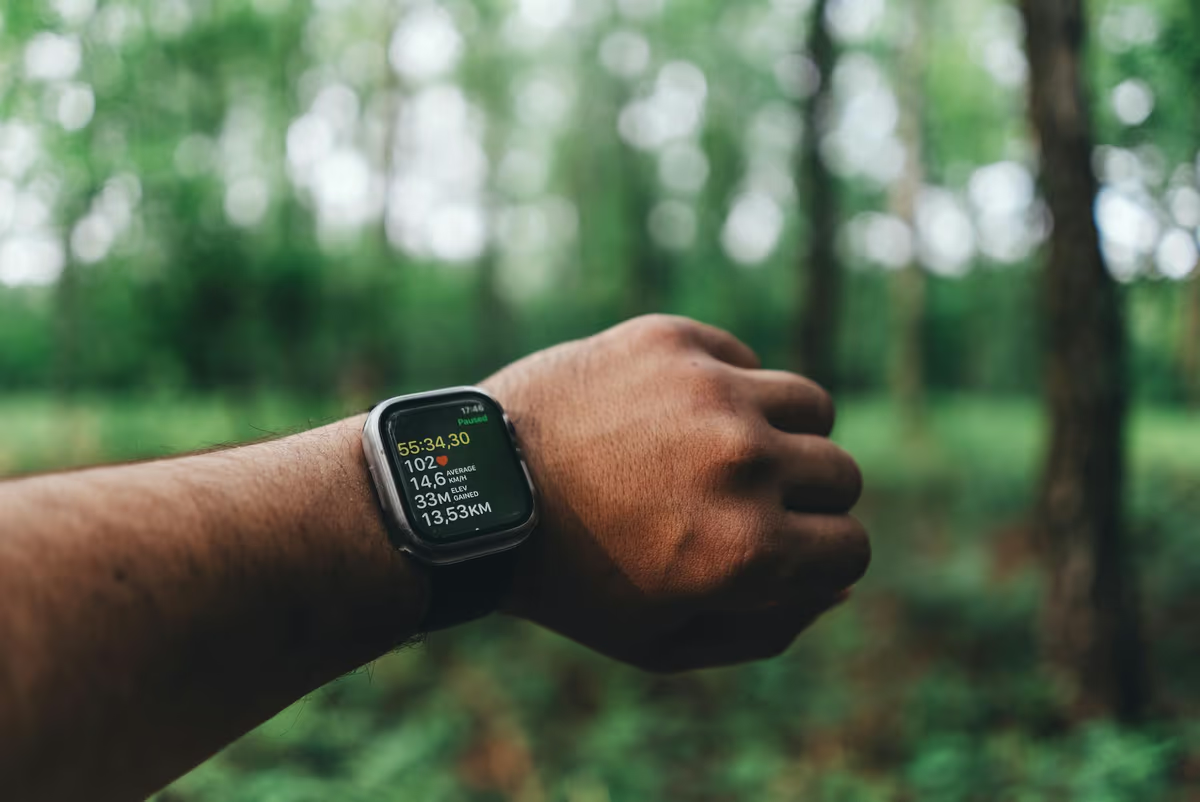
The model also pulls in activity data — heart rate from a smartwatch, motion sensors in a phone — to work out what kind of exercise is happening. That matters, because not all movement is equal.
Structured versus unstructured movement
One finding surprised me enough to make me put my coffee down. Two types of movement that, on paper, look similar showed very different hypo risk:
- Unstructured, free-living aerobic activity — a long walk, a hike, a day of garden work — carried a higher hypo risk.
- Structured exercise — a guided aerobic session (jogging, cycling, swimming), resistance training, or interval work — carried a lower hypo risk.
The authors are careful not to claim structured exercise is inherently safer. A more honest explanation, supported by earlier Canadian work, is that people prepare for structured workouts. They check glucose, front-load carbs, cut insulin, and go in with a plan. Someone who decides mid-afternoon to dig up the garden often does none of that.
I do none of that, regularly. The number of times I have walked three kilometres to the shops “for five minutes” and limped home with Skittles in my mouth is higher than I would like to admit. The takeaway is not stop walking. It is this: treat the spontaneous movement with the same pre-flight check as the planned workout. The AI cannot save you if you don’t give it any warning.
What I actually do before a workout today
Until the model is living in my pump or my phone, the prediction job is still mine. Here is the checklist I run — in the same order, every time — for planned and unplanned movement alike.
1. Check the trend, not just the number
A Dexcom reading of 6.5 mmol/L (117 mg/dL) with a flat arrow is a different animal from 6.5 with a downward arrow. I treat a falling arrow like an instruction to wait, not a dare.
2. Look back at the last 24 hours on CGM
If my clarity graph shows time below range overnight, I assume my body is primed for another low and eat a little more, dose a little less, or push the workout to later in the day.
3. Count insulin on board honestly
This is where my pump earns its keep. If I’m still in the tail of a meal bolus, I treat that as pre-paid hypo currency and either eat carbs before I start or delay the workout by 30-45 minutes.
4. Match the plan to the movement
I plan differently for a 45-minute hilly run than for 20 minutes of sprints or an hour of resistance. Aerobic goes lower; resistance often stays steady or rises; intervals are unpredictable. My care team helped me build three separate playbooks for those cases — and I rehearse them, boringly, like safety drills.
5. Carry sugar, always
No algorithm replaces the gel in my pocket. Not yet, probably not ever.
What this could change on pumps and pens
If a risk score like this ends up inside your tech, it could work differently depending on what you wear.
On an automated insulin delivery (AID) pump — Omnipod 5, Tandem Control-IQ, Medtronic 780G — the algorithm could quietly ease basal delivery in the window before exercise, raise your target, or prompt you to eat a small snack. Some research groups are exploring dual-hormone systems that deliver a tiny dose of glucagon when cutting insulin alone is not enough. That is the dream version, at least a few years away.
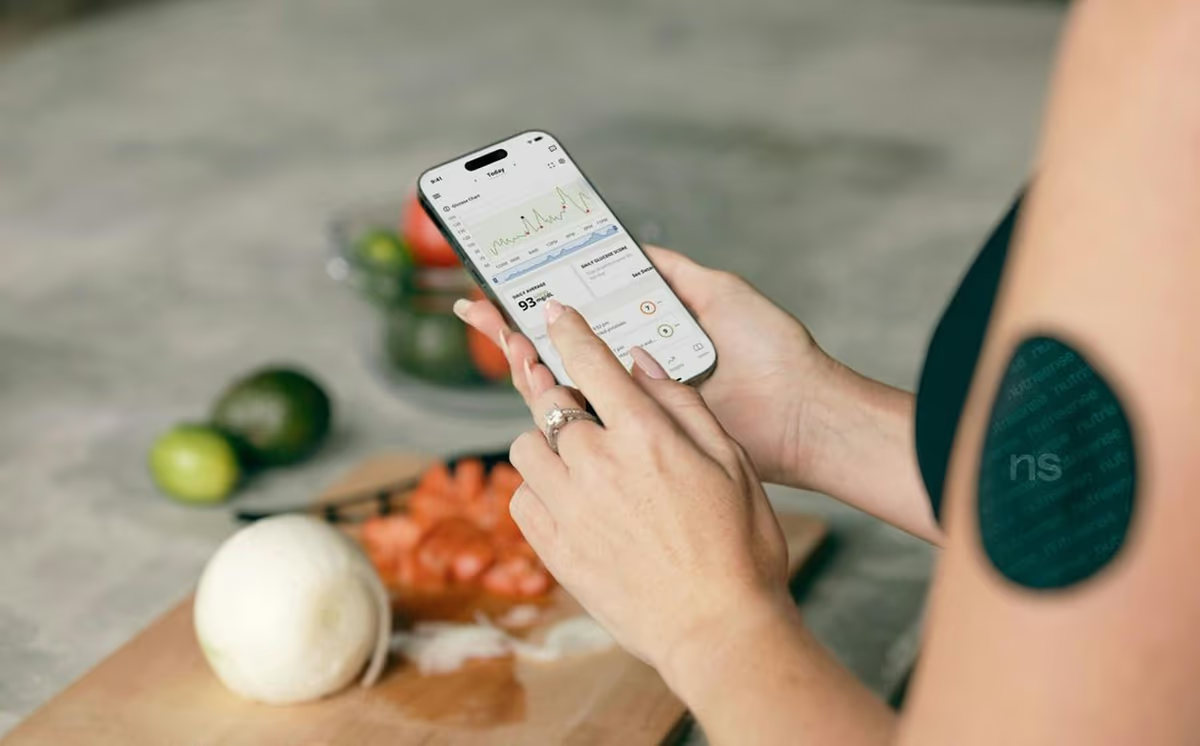
On multiple daily injections, the same model could live in an app beside your CGM. Instead of changing insulin for you, it would surface a heads-up: “your glucose is drifting down, you still have insulin on board from lunch, and you’re about to start a long walk — consider a small snack, or push the walk by 30 minutes.” The choice stays with you. The alert stops you from finding out the hard way, after you’re already shaky.
What we still do not know
It is worth being honest about the limits. The authors point out that to get more accurate, the model will need exercise intensity, perceived exertion, and even competition stress — signals hard to capture from a wristwatch alone. None of the major device makers has published a shipping date.
There is also a bigger question no algorithm can answer for you: how you respond to a specific type of movement on a specific day. Heat, sleep, the menstrual cycle, the 4 a.m. low you half-slept through — these all affect the next workout and most live outside the data stream. A prediction model can nudge you toward a better decision. It cannot replace the personal pattern recognition you build with your CGM and your care team.
Red flags — when to talk to your team before relying on any of this
Before you trust an algorithm or your own gut to get you through a workout, there are a few situations that belong in your endocrinologist’s office first:
- You have had a severe hypo (needing help from someone else) in the last 6 months
- You have hypoglycemia unawareness — the shakes and sweats don’t show up anymore
- You are pregnant, planning pregnancy, or recently postpartum
- You are new to a pump, new to a CGM, or new to exercise after a long break
- You are training for a competitive event (a marathon, a triathlon) that will change your carb and insulin needs for weeks
These are not reasons to stop moving. They are reasons to build your exercise plan with a human specialist in the room — and keep doing the same careful prep our technology is only now learning to copy.
What to take on your next run
Exercise does not have to be a coin flip between a good workout and a bad low. The research out of the BETTER registry and the T1D Exercise Initiative shows that the signals needed to forecast a pre-exercise hypo are already in my data, and probably in yours — and a model that reads them at scale is getting close to useful. It is one of the more practical fronts in diabetes technology right now, less flashy than artificial pancreases and cell therapy but arguably closer to helping us in the next few years.
While the tech catches up, the same playbook still applies: look at your trend arrow and your recent lows, count the insulin on board, and match your plan to the movement you’re actually about to do. Then talk to your care team about tightening that plan. The AI may show up in your pump or phone soon.
Here is what a lifetime with T1D has taught me — your judgement, thankfully, is already here.
— John Chitta
This article builds on the T1D Exercise Initiative’s 2023 paper in Diabetes Technology & Therapeutics and follow-up commentary in the Canadian Journal of Diabetes. Brand mentions (Dexcom, Omnipod, Tandem, Medtronic) are personal references based on four decades of living with type 1 diabetes, not sponsorships or endorsements. Always consult your endocrinologist, diabetes educator, or exercise physiologist before changing any part of your management plan.
References
- The Type 1 Diabetes and Exercise Initiative: Predicting Hypoglycemia Risk During Exercise Using Repeated Measures Random Forest · PubMed (Diabetes Technology & Therapeutics, 2023)
- Management strategies and hypoglycemia risk during and after physical activity in adults with T1D · Canadian Journal of Diabetes (2022)
- Barriers to Physical Activity Among Patients With Type 1 Diabetes · Diabetes Care (2008)
- Exercise Management in Type 1 Diabetes: A Consensus Statement · The Lancet Diabetes & Endocrinology (2017)
- ADA Standards of Care — Physical Activity and Exercise · American Diabetes Association (2024)